Thursday, July 25, 2013

Tungsten for Defense

Tungsten for Defense

Advanced Hit Efficiency and Destruction

AHEAD is the acronym of "Advanced Hit Efficiency and Destruction". That AHEAD can also mean "ahead of ….", is indicative of the idea that AHEAD ammunition is a guided missile that is activated and deployed prior to reaching the target, "advancing interception". The core of AHEAD technology is made up of three parts, including AHEAD ammunition, muzzle velocity measurement, and timed detonator device/ data request system.

Below involve the pictures of a typical military application of tungsten alloy in the tungsten military defense (GDF-AHEAD, from Switzerland):

tungsten military defense

Schematic drawing of tungsten military defense( heavy metal tank ammunition cartridge)
tungsten military defense

1. Windshield
2. Tungsten heavy-metal penetrator (sub projectile)
3. Three-section sabot
4. Stabilizing fin
5. Propellant of tungsten military defense

Multi-EFP
Multi-EFP and the combined effect of EFP
(a)Single EFP
(b)The EEP fighting the Department of the composition
(c)Multi-EEP
(d)Integrated effect of EEP

Technological Core of Tungsten Military Defense

The 35mm by 228mm AHEAD ammunition is an original cartridge type, programmed detonator ammunition, composed of a Programmable Fuze System, tungsten alloy subprojectiles, ejection standoff ammunition, a thin-walled body, nitrified fibre firing ammunition and steel ammunition cartridge. This tungsten military defense is become more and more widely used in the military field.

Tungsten Military Defense in Anti-missile:

In the anti-missile role it uses Advanced Hit Efficiency And Destruction (AHEAD) ammunition. This round ejects 152 tungsten projectiles at a predetermined distance, between 40 and 10 m, from the target. A 25-round burst of AHEAD rounds produces 3,800 of these small projectiles to destroy the incoming missile. Cruise missiles can be destroyed at 2.5 km and high speed missiles at 1.5 km range by tungsten military defense. A more common projectile to see in service is the advanced hit efficiency and destruction [AHEAD] round. Given the size of the diameter and the larger length of the projectile, as opposed to a 35mm AHEAD round, more subprojectiles are carried - one hundred and eighty as opposed to one hundred and fifty-two . The submunitions of this tungsten military defense are tungsten-alloy [WHA] spheres, designed for both penetration and 'mass effect', to increase the likelihood of engaging the incoming 'vampire' or 'bogie'. The round is termed the MCP170 and uses a programmable magnetic fuze which uses information provided by the coil velocity gauge near the gun's muzzle in order to automatically compute the correct estimated time to target.

More knowledge of tungsten military defense for AHEAD C141:

The combat efficiency of the AHEAD ammunition is due to the payload of 152 tungsten alloy subprojectiles weighing 3.3 grams each. These subprojectiles are activated at a certain distance in front of the intercepted target, forming a mass of lethal subprojectiles, greatly augmenting the probability of a kill. The tungsten alloy subprojectiles have a sharp edge, ensuring that this tungsten military defense can inroad into the target with precise accuracy, tungsten military defense also provides the kinetic energy to destroy the electrical components, payloads or motor of the target.

Wednesday, July 24, 2013

Tungsten Alloy Military Fittings

Tungsten Alloy Military Fittings

tungsten alloy military fitting
Why Tungsten Heavy Alloy Is Adopted in Military Defense?

Nowadays, tungsten alloy is increasingly adopted as the raw material for military defense, and works as tungsten alloy military fitting, such as bullet, armor and shells, shrapnel head, grenade, bulletproof vehicles, tanks panzers, cannons, firearms, etc. A major tungsten alloy military fitting is in kinetic energy penetrators, where military defenses are in direct competition with depleted uranium (DU). Recent investigations conducted at the Army Research Laboratory show that DU's superior properties resulted from its ability to localize shear during ballistic penetration events. Therefore, military defense was argued that if localized shear can be imparted to tungsten alloy, this material would exhibit penetration performance matching that of depleted uranium (which had become an environmental problem).

You can image the subject envisions a penetrator, dropped from service height of a bomber aircraft, using kinetic energy to penetrate the shielding, and subsequently deliver a nuclear explosive to the buried target.

The problem with such a penetrator is the tremendous heat applied to the penetrator unit when striking the military defense shielding (surface) at hundreds of meters per second. Military defense has partially been solved by using metals such as tungsten (with a much higher melting point than steel), and altering the shape of the projectile (such as an olive). (You can get more information from http://en.wikipedia.org/wiki/Nuclear_bunker_buster)

During the World War Ⅱ, tungsten has already been used as an important raw material for military defense. There were abundant wolfram ore reserves found then in Portugal, which were used to produce tungsten concentrates for military defense.

Tungsten Heavy Alloy for Military Defense and Applications

In order to reduce the adoption of environmental hazardous materials in the military defense field, tungsten alloy military fitting is used as a non-toxic alternative for lead and depleted uranium in bullet and shot. High-density metal such as tungsten alloy military fitting is now widely employed; the goal of military defense is to create functional, high density, non-toxic arms projectiles with controlled impact behavior. The special properties of tungsten alloy make it almost ideal material for military defense applications.

Owing to its great hardness and resistance to high temperature, usage of tungsten alloy military fitting has been steadily increasing since the 1940's.

Tungsten alloy military fitting applications:

*Tungsten alloy bullet
*Shrapnel head
*Balanced ball for missile and plane
*Core for armor-piercing bullet measurement
*Kinetic energy penetrators
*Armor and shells
*Grenade
*Rocket components

Tuesday, July 23, 2013

Tungsten Alloy Counterweight Advantages

Tungsten Alloy Counterweight Advantages

tungsten alloy counterweight
Tungsten alloy counterweight is widely used as counterbalance an opposing mass in a linear or rotary motion system as for its counterweight.

Tungsten alloy is always used for counterbalance an opposing mass in a linear or rotary motion system, allowing movement with lower driving forces.

Tungsten alloy counterweight is designed for aircraft control surfaces, aircraft rotor blades, guidance platforms, and vibration dampening governors. Take vibration dampening governor for instance, tungsten counterweight is used to reduce vibrations in rotating systems such as automobile tires. The vibration is measured without any weights and the heavy spot is determined. It is then placed opposite this heavy spot to balance the load and reduce or eliminate the vibration.

The reasons for adopting tungsten can also be made out of metals such as iron, steel and various alloys. However, tungsten alloy with high density becomes the most popular used material. Take tungsten alloy golf counterweight for instance. When counterweight golf, somebody have the thought of that if they want more distance and control, the conventional wisdom calls for lighter overall weight. But it turned out to be wrong.

Monday, July 22, 2013

Tungsten Ball Pen Bead

Tungsten Ball Pen Bead

tungsten alloy ball
Ballpoint pen or ball-pen is a kind of worldwide popular writing tools in recent decades. It has a simple structure, is easy to carry, provides writing lubrication and it is suitable used as autotype.

Tungsten alloy ball has many advantages, such as high density, small volume, excellent hardness, superior wearing resistance, high ultimate tensile strength, high ductility, high temperature resistance, etc. has a density twice that of steel and are more than 50% heavier than lead, so it is a very suitable material to make into ballpoint bead. These features provide stability when writing, so tungsten alloy ball pen bead will make writing easy and enjoyable. Its wear resistant is the key factor for the manufactures to produce tungsten alloy ball pen bead.

We produce variety of tungsten alloy ball pen bead with diameters of 0.38 - 1.4mm. Our tungsten alloy ball has advanced production techniques and international technical level. Hardness>1400-1500, roughness Ra0.063-0.8 micron, Diameter Tolerance <0.001mm, lineation2000-2500m, wear-out<0.003mm, microspore uniform distribution, writes smoothly, lineation clearing, abrasion proof, long using life , printing ink' wet ability well, carry over more printing ink, lineation clearing ; good handle ,taking bake superabundant printing ink.

All of above superiors make tungsten alloy ball as the best choice for our everyday used pens. Please contact us without hesitation if you have any questions.

Tungsten alloy ball is used in the production of pen bead, tip of ballpoint is generally made of two kinds of material, and one is stainless steel beads and other kind is tungsten alloy ball pen bead. High quality ballpoint tip is made of pure tungsten ball. Ballpoint tip tungsten ball can be used for a long time, and makes writing is also very fluent.
Tungsten alloy ball pen bead is a kind of use the tiny round pearl rotation of the pen, the round pearl by brass, steel or made of tungsten alloy ball, can you write in ink onto the paper will release. Tungsten alloy ball pen bead is different with the reed pen, feather pen, metal tip pen and fountain pen.

How Does Tungsten Alloy Ball Make into Pen Bead?

Tungsten alloy is first made into standard size ball. Then spread out in a groove with the bond and formed into little particles within circular groove, showing tops only. Heavy flat ceiling disk is placed, pressuring little particles from above. In between two dishes into the grinding oil, make these little particles containing diamond powder soaked in gliding mixture. The next step is to turn the footwall, making particles of tungsten alloy ball circular groove constantly tempestuous rolling, in particular of the trench wall, with each other and constant contact, diamond powder keep these particles of the horn side grinding away, they gradually become rounded and light. It takes dozens of hours to finish one tungsten alloy ball pen bead.

Sunday, July 21, 2013

Tungsten Alloy Sphere for Counterweight

Tungsten Alloy Sphere for Counterweight

tungsten alloy sphere
Tungsten alloy sphere counterweights are incorporated into the pitch control system of many propeller designs as a fail-safe device to prevent over speeding. What's more, tungsten heavy alloy is incorporated into the rotating flywheels of gyroscopic controls for the storage of kinetic energy. Tungsten alloy counterweights are used for adjusting the center of gravity of the triangle and the frequency of oscillation of the laser beams. Bucking bars made of tungsten heavy alloy are ideal for vibration-damping applications with high density.

Usually, space for the counterweight is limited, so the need of heavy but small objects is great. Tungsten alloy sphere, with the density of 16.5/ cm 3 to 18.5/m3 about 50 percent higher than lead and much higher than steel, is ideal for counterweight. Tungsten alloy counterweight as sphere can prolong the life of itself because of its wear resistance and round shape. In addition, lead is toxic while tungsten alloy sphere is environmentally friendly.

Tungsten Alloy Sphere Application

Due to its special properties, tungsten alloy sphere use in the counterweight, fishing weight, counterweights, etc. Chinatungsten has more than 20 years of experience in manufacturing tungsten alloy counterweight as sphere. We have tungsten alloy sphere to many different overseas customers and manufactured various parts of tungsten alloy counterweight always meeting specific designs requirement. Tungsten alloy sphere are usually supplied in bulk quantities.

Advantages of Tungsten Alloy Counterweight as Sphere

Tungsten alloy sphere provides a safer alternative to lead, and their higher density enables them to hold their shape better, even under extreme conditions. While uranium offers comparable density, its volatile nature and the special licensing requirements needed for radioactive materials make working with it difficult. Chinatungsten offers a variety of high-density alloys, available as ROTF (Rough, Oversized to Finish) material, bars, tungsten alloy sphere, tungsten alloy counterweight, tungsten alloy plates or rods. We also have extensive machining capabilities, allowing us to provide crankshaft weights in standard sizes or custom products finished to your exact specifications.

Thursday, July 18, 2013

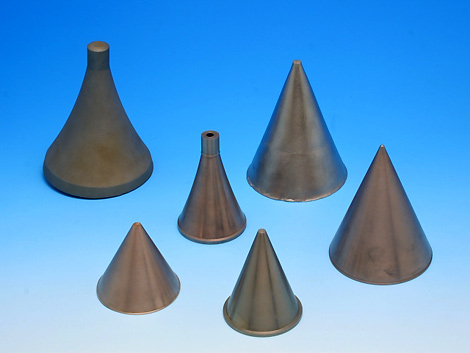
Tungsten Alloy for Shaped Charge Liners

Tungsten Alloy for Shaped Charge Liners

tungsten alloy shaped charge liner
What are Shaped Charge Liners?

A shaped charge liner is an explosive charge shaped to focus the effect of the explosive's energy. Various types are used to cut and form metal, initiate nuclear weapons, and penetrate armor. A typical modern lined shaped charge can penetrate armor steel to a depth of seven or more times the diameter of the charge's cone (cone diameters, CD), though greater depths of 10 CD and above are now feasible.

The shape most commonly used for the liner is a cone, with an internal apex angle of 40 to 90 degrees. Different apex angles yield different distributions of jet mass and velocity. Small apex angles can result in jet bifurcation, or even in the failure of the jet to form at all; this is attributed to the collapse velocity being above a certain threshold, normally slightly higher than the liner material's bulk sound speed. Other widely used shapes include hemispheres, tulips, trumpets, ellipses, and bi-conics; the various shapes yield jets with different velocity and mass distributions.

Liners have been made from many materials, including glass and various metals. The deepest penetrations are achieved with a dense, ductile metal, and a very common choice has been copper. For some modern anti-armor weapons, molybdenum and pseudo-alloys of tungsten filler and copper binder (9:1 thus density is ~18t/m3) have been adopted. Just about every common metallic element has been tried, including aluminum, tungsten, tantalum, depleted uranium, lead, tin, cadmium, cobalt, magnesium, titanium, zinc, zirconium, molybdenum, and beryllium, nickel, silver, and even gold and platinum. The selection of the material depends on the target to be penetrated; for example, aluminum has been found advantageous for concrete targets.

Why Choose Tungsten Alloy as Shaped Charge Liners?

For the deepest penetrations, pure metals yield the best results, because they display the greatest ductility, hence postponing the breakup of the stretching jet into particles. In charges for oil-well completion, however, tungsten alloy shaped charge liner is essential that a solid slug or "carrot" not be formed, since it would plug the hole just penetrated and interfere with the influx of oil. In the petroleum industry, therefore, liners are generally fabricated by powder metallurgy, often of pseudo-alloys, which if tungsten alloy shaped charge liners un-sintered, yield jets that are composed mainly of dispersed fine metal particles.

During World War II, shaped charge liners were made of copper or steel, though other materials were tried or researched. The precision of the charge's construction and shaped charge liners detonation mode were both inferior to modern warheads. This lower precision caused the jet to curve and to break up at an earlier time and hence at a shorter distance. The resulting dispersion decreased the penetration depth for a given cone diameter and also shortened the optimum standoff distance. Since the charges were less effective at larger standoffs, side and turret skirts fitted to some German tanks to protect against Russian anti-tank rifle fire were fortuitously found to give the jet room to disperse and hence reduce its penetrating ability. Now most shaped charge liners are made of tungsten alloy.

The use of shaped charge liners today may increase the penetration of some warheads. Due to constraints in the length of the projectile/missile, the built in stand-off on many warheads is not the optimum distance. The skirting effectively increases the distance between the amour and the target, providing the warhead with a more optimum standoff and greater penetration if the optimum stand-off is not drastically exceeded. Tungsten alloy shaped charge liners should not be confused with cage amour that is used to damage the fusing system of RPG-7 projectiles. The amour works by deforming the inner and outer orgies and shorting the firing circuit between the rocket's piezoelectric nose probe and rear fuse assembly. If the nose probe strikes the amour, the warhead will function as normal.

The spacing between the shaped charge liners and shaped charge liners target is critical, as there is an optimum standoff distance to achieve the deepest penetration. At short standoffs, the jet does not have room to stretch out, and at long standoffs, shaped charge liners eventually breaks into particles, which then tend to drift off the shaped charge liners of axis and to tumble, so that the successive particles tend to widen rather than deepen the hole. At very long standoffs, velocity is lost to air drag, degrading penetration further.

Wednesday, July 17, 2013

Tungsten for Gyroscope Rotors

Tungsten for Gyroscope Rotors

tungsten alloy gyroscope rotor
What Is Tungsten Alloy Gyroscope Rotors?

A tungsten alloy gyroscope rotor is a device for measuring or maintaining orientation, based on the principles of angular momentum. A mechanical they are essentially a spinning wheel or disk whose axle is free to take any orientation. This orientation changes much less in response to a given external torque than it would without the large angular momentum associated with the gyroscope's high rate of spin. Since external torque is minimized by mounting the device in gimbals, its orientation remains nearly fixed, regardless of any motion of the platform on which it is mounted. Solid state gyroscopes also exist.

Applications of Tungsten Alloy Gyroscopes Rotors

Applications of tungsten alloy gyroscopes rotors include navigation (INS) when magnetic compasses do not work (as in the Hubble telescope) or are not precise enough (as in ICBMs) or for the stabilization of flying vehicles like Radio-controlled helicopters or UAVs. Due to higher precision, tungsten alloy gyroscope rotors are also used to maintain direction in tunnel mining.

Gyroscope rotors exhibit a number of behaviors including precession and notations. Tungsten heavy alloy gyroscope rotors can be used to construct gyrocompasses which complement or replace magnetic compasses (in ships, aircraft and spacecraft, vehicles in general), to assist in stability (bicycle, Hubble Space Telescope, ships, vehicles in general) or be used as part of an inertial guidance system. It effects are used in toys like tops, boomerangs, yo-yos, and Powerball's. Many other rotating devices, such as flywheels, behave gyroscopically although the gyroscopic effect is not used.

Tungsten alloy gyroscope rotors in operation have freedom of movement in all three axes. The tungsten alloy gyroscope rotors will maintain its spin axis direction regardless of the orientation of the outer frame. With its perfect properties, tungsten alloy is the perfect material for gyroscope rotors.